Why Your Income Resets to Zero Every Month — And How to Fix It
May 05, 2026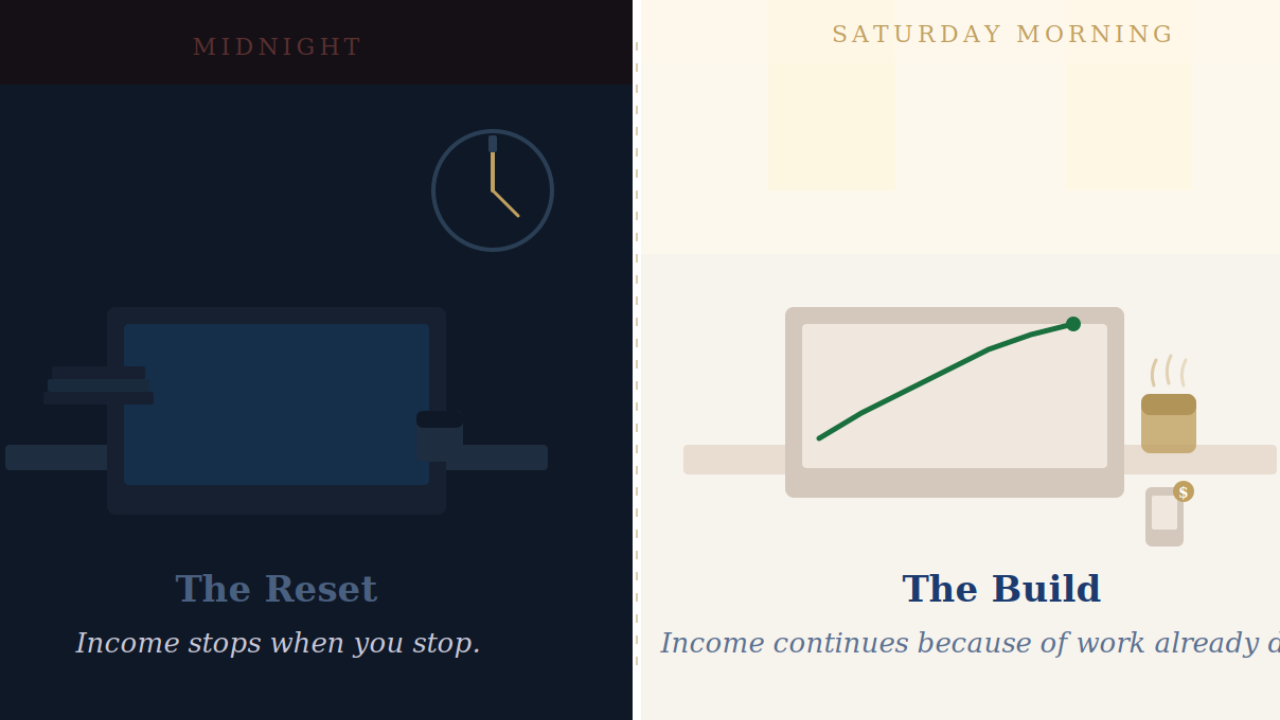
There’s a pattern most people in traditional careers never talk about out loud. Every month, no matter how hard you worked the month before, the clock resets. The income stops. The pressure restarts. You wake up on the first of the month essentially back at zero, rebuilding from scratch.
It doesn’t matter if you had your best month ever. It doesn’t matter if you closed deals, billed hours, or crushed your quota. When the calendar flips, you start over.
Most people accept this as just how income works. It doesn't.
The Trap Nobody Warns You About
I spent 17 years as a litigation attorney. Harvard Law degree. My own firm. By every external measure, a successful career. But in October 2021, sitting at my desk close to midnight after filing yet another lawsuit, I checked my bank account and felt something unexpected: exhaustion. That month I had generated over $47,000 in revenue as a solo practitioner. Strong numbers. But none of it meant I could slow down — because the moment I did, it all stopped.
My time was not my own. Every dollar I earned was tied directly to hours worked, problems handled, and fires put out.
I wasn’t building anything. I was maintaining momentum. There’s a difference — and once you see it, you can’t unsee it.
That’s the trap. It doesn’t announce itself. It just quietly shapes your entire relationship with work, time, and freedom. You build skill, you build reputation, you build income — but you never build leverage. The second you stop, everything stops with you.
Trading Time for Money Is Not a Business Model
Most income models — whether you’re an attorney, a sales rep, a consultant, or a contractor — share the same fundamental structure: you show up, you produce, you get paid. Stop showing up and the production stops. The payment stops.
It’s a rental model. You’re renting your income every single month.
The problem isn’t the effort. Most people in this situation are working incredibly hard. The problem is the structure. No matter how efficient you get, no matter how good you become, there’s a ceiling built into the design. That ceiling doesn’t move just because you work harder.
This is the income reset. Every month, the counter goes back to zero. You’re not building equity in your time. You’re spending it.
What Residual Income Actually Is
There’s a completely different model — one that most people in traditional careers never encounter until later in life, if ever. It’s called residual income, and it works in the opposite direction.
Instead of your income stopping when you stop working, residual income continues because of work you already did. The accounts you build, the relationships you establish, the systems you put in place — they keep producing revenue month after month, regardless of whether you show up that day.
In the merchant services industry, this model is the foundation.
Here’s how it works: every time a business processes a payment, a small fee is generated. When you’re the agent who brought that business into the system, you earn a portion of that fee — every month, for as long as that business keeps processing transactions.
One account might generate $40 or $80 per month. That doesn’t sound significant on its own. But you’re not building on a single account. You’re building a portfolio.
The Math That Changes Everything
This is where most people’s thinking shifts.
According to our model outlined in the Payments Playbook, if the average account generates $50 per month in residual income, here’s what consistent activity looks like over time: after six months and 60 accounts, you’re looking at $3,000 per month. After 12 months and 120 accounts, that grows to $6,000 per month. By months 18 to 24, a portfolio of 200 or more accounts can generate $10,000 or more per month.
Those numbers don’t account for larger accounts, higher-margin deals, or referrals that accelerate your pace. They’re based on steady, consistent activity — not a single lucky break.
The critical difference is that you’re not rebuilding from zero every month. You’re adding to a foundation that already exists. Each new account stacks on top of the previous ones. That’s compounding. And compounding changes the entire math of income.
I built a portfolio generating over $15,000 per month in residual income within my first 12 months in the industry. Not from one deal, and not from luck. From understanding the model and executing it consistently.
Why This Industry Specifically
Merchant services is one of the few industries where this model is genuinely accessible to a new entrant — not just to large institutions or people with significant capital.
The reason is straightforward: every business in America processes payments, and most of them do it inefficiently. Most business owners don’t fully understand what’s happening behind the scenes — the fees they’re paying, the systems they’re using, the operational friction they’ve simply learned to live with. That creates a real and recurring opportunity.
As an agent, you’re not a salesperson pitching credit card machines. You’re a payment professional who helps businesses understand how money moves through their operations and how that process can be improved. When you do that correctly, you create genuine value — and value creates long-term relationships.
Those relationships are what generate the residual income. The business keeps processing, and you keep getting paid.
The Moment the Model Became Real
On a Saturday morning in April 2023, I woke up early to go to CrossFit and, before I left, I opened my banking app to find an ACH deposit for $90,000. Earlier that week, I had sold a portion of my monthly residual commissions, and this was the first installment hitting my account.
Later that morning, sitting in a coffee shop after the gym, I had a simple thought: this is a completely different model.
No clients were waiting on me. There were no deadlines. Nobody needed anything from me that morning. The income was the result of work already done — a portfolio of accounts continuing to process, continuing to generate revenue, whether I was at my desk or not.
That’s what the income reset problem looks like when it’s solved.
The Real Shift Isn’t Financial — It’s Structural
The most important thing to understand about residual income isn’t the dollar amount. It’s what the structure actually changes.
When your income is tied directly to your time, you can never fully step away. Vacations come with anxiety. Weekends come with email. You build a career, but you never build freedom, because everything depends on you continuing to show up at exactly the same pace.
When your income is tied to a portfolio, the relationship with your time changes fundamentally. You still work — the early stages of building require real, consistent effort. But over time, the effort compounds instead of resets. The work you did six months ago is still paying you. The accounts you signed a year ago are still generating income.
That’s not passive in the “do nothing” sense. It’s passive in the “the work you already did keeps working” sense. For most people who have spent their careers in the reset model, experiencing that difference for the first time changes the way they think about work completely.
How to Stop the Reset
The path into this model isn’t complicated, but it does require understanding the business correctly from the start.
Most people who enter the payments industry are handed a script, a pricing sheet, and told to go sell. That approach produces limited results — and it misses the entire point of what makes this opportunity real.
The agents who build meaningful residual income portfolios approach this differently. They learn how businesses actually work. They identify inefficiencies. They solve real operational problems. They build relationships based on value, not just price. That’s the framework the Payments Playbook was built around, and it’s what separates the people who build something durable from the ones who end up right back where they started.
The income reset is a design problem, not a willpower problem. The solution isn’t working harder inside the same model. It’s building a different one.
If you’re ready to understand how the residual income model actually works — the mechanics, the math, and the real-world path to building it — the Payments Playbook is the place to start.
Download the Payments Playbook — Free
Robert M. Fojo is a Harvard Law graduate and former litigation attorney who built a residual income portfolio generating over $15,000/month within his first year in merchant services. He founded Payment Operators to teach others the same system.
Stay connected with news and updates!
Join our mailing list to receive the latest news and updates from our team.
Don't worry, your information will not be shared.
We hate SPAM. We will never sell your information, for any reason.